
He is survived by two sons, Rajiv Bajaj and Sanjiv Bajaj, and a daughter Sunaina Kejriwal.

The country's gross domestic product (GDP) growth is likely to be 8.8 to 9 per cent in the current financial year, driven by agriculture and industry sectors, Care Ratings said in a report. The country's economy had contracted by 7.3 per cent in fiscal 2020-21. The agency said the outlook for the Indian economy on almost all counts in FY22 would look seemingly better than FY21 on account of the negative base effect.

Ajit Balakrishnan offers a thinking man's guide to the state of ecom in a nation of shopkeepers.

The proposed amendments to the Consumer Protection (E-Commerce) Rules, 2020, that are envisioned to protect consumer interests, may further compound the impact of multiplicity of regulations on the e-commerce sector, the Indo-American Chamber of Commerce (IACC) had told the ministry of consumer affairs. IACC, the apex bilateral chamber for Indo-US business, had told the government that the proposed amendments would increase compliance liabilities that risk severely impairing the growth of the sector.

The US on Thursday raised concerns over India's Personal Data Protection (PDP) Bill and draft non-personal data governance framework, claiming these could potentially threaten innovation and economic growth. In its latest 'Special 301' Report, the US Trade Representative (USTR) kept India on the priority watch list, maintaining the country remains one of the world's most challenging major economies with respect to protection and enforcement of intellectual property (IP). In December 2021, a joint parliamentary committee released a report recommending changes to the PDP Bill, 2019, that could undermine important IP protections in India.

'India has many attractive features for the long-term investor; it combines: A low per capita income, a young population, and a heavier presence of high margin, asset-light firms in the technology sector.'

The Israeli ambassador said the efficiency of the agriculture sector as a whole will increase with the new legislations and consumers will also enjoy better and fresh crops.

When it comes to losing a job permanently, the youngest and the oldest segments in the workforce have reported an increase in setbacks in the second wave of the pandemic, a survey of by a Fortune500 company has said. The survey, conducted in April this year, covered 2,000 persons in India. Six per cent of those over 55 years of age reported having permanently lost their job, as against 4 per cent last year. In those aged under 24, the proportion reporting a permanent job loss has increased to 11 per cent from 10 per cent in the year-ago period, the survey done by financial technology company FIS said.

'Who would think of making a bank of poor women? She had vision and boldness.'

While the UK will possibly go into recession, the bigger fear is copycat referendums from other EU nations.

A key trigger for the increased retail participation in equities has been the lockdown triggered by Covid-19 that saw investors channelising their savings to capital markets in search of better return on their investments and the need to increase their disposable income.

More than 1,400 people have signed an e-petition on the UK government website calling to 'Reverse Mango Import Ban.'

In December, Aisha Shah was named as Partnerships Manager at the White House Office of Digital Strategy.

S&P Global Ratings on Thursday cut India's growth forecast for the current fiscal to 9.5 per cent, from 11 per cent earlier, and warned of risk to the outlook from further waves of COVID pandemic. The agency lowered the growth outlook saying that a severe second COVID-19 outbreak in April and May led to lockdowns imposed by states and sharp contraction in economic activity. "We forecast growth of 9.5 per cent this fiscal year from our March forecast of 11 per cent," S&P said.

How should one billion Indians, for whom deprivation has become an inescapable way of life, join us in celebrating 75 years of Independence? And where do we go from here? asks Kalyan Singhal.

ONGC was the top loser in the Sensex pack, shedding 4 per cent, followed by Bharti Airtel, SBI, IndusInd Bank, NTPC, Sun Pharma and ITC. On the other hand, Bajaj Finance, Bajaj Auto, Reliance, Bajaj Finserv and Asian Paints were among the gainers.

Mid- and small-cap indices have outperformed the frontline benchmarks - the S&P BSE Sensex (up around 10 per cent) and the Nifty50 (13 per cent) - in the first half of calendar year 2021 (H1-CY21) by rallying 26 per cent and 39 per cent, respectively. The trend, analysts believe, is likely to continue in H2-CY21 as well. The outperformance in H1-CY21 comes on the back of improved earnings and strong inflows from the foreign portfolio investors (FPIs) in Indian equities. However, good monsoon so far, gradual opening up of the economy and the pick-up in the pace of vaccination provides support to the market.

Centre and state governments are steadily increasing excise duties and value-added tax

India's manufacturing sector activities moderated in August, as business orders and production rose at softer rates due to the pandemic and rising input costs, a monthly survey said on Wednesday. The seasonally adjusted IHS Markit India Manufacturing Purchasing Managers' Index (PMI) stood at 52.3 in August, down from 55.3 in July, indicating a softer rate of growth that was subdued and below its long-run average. The August PMI data pointed to an improvement in overall operating conditions for the second straight month.

Why Kia is keen to drive into India? The Korean automobile maker plans to carve out a niche for itself in the crowded Indian market with its compact sedans and SUVs.

The seasonally adjusted India Services Business Activity Index rose from 45.4 in July to 56.7 in August, as the reopening of several establishments and increased consumer footfall boosted sales. The services sector witnessed the first expansion in output in four months and a rebound in business confidence.

Could it have been more reformist? Of course, but this is an election year Budget, observes Akash Prakash.

Even if the Paytm fiasco does not mark the end of the bull run, at least some sanity will return to the wild IPO market, observes Debashis Basu.

Like on Pegasus, like Covid, there have been no answers from the government about why the situation on the economy and India's future is where it is today, notes Aakar Patel.

Dell emerges the most attractive among technology players.

A lesson we have not learnt from China is the urgent need to knit the vast country together to keep it from falling apart at the seams. While there is considerable dent in poverty, sadly, the North East remains as distant today as it always was, points out Shreekant Sambrani.

Johnson's first visit to India as United Kingdom prime minister will begin on April 21 with a trip to Ahmedabad in Gujarat, which is Prime Minister Modi's home state.

Macroeconomic data announcement, Omicron situation and global trends will be the major driving factors for the equity market in the first week of the new year 2022, according to analysts. In what turned out to be a historic year, the Indian stock indices went past multiple milestones and the 30-share Sensex made an annual gain of 10,502.49 points or 21.99 per cent in 2021. Religare Broking Vice-President (Research) Ajit Mishra said, "This week marks the beginning of a new month and participants will be closely eyeing some crucial high-frequency data like monthly auto sales, India manufacturing PMI and India services PMI. "Besides, updates on the COVID-19 situation and performance of global markets will also be critical."

'It is critical that the Covid curve does not have a fat tail and the chain is broken quickly.'

Even as India's internet base continues to widen, with the country set to have over 900 internet users by 2025, a parallel rise in cyber threats has become a matter of huge concern. Experts say that the sudden surge in digital adoption left little time to develop a cybersecurity backbone for the country. This has put large amounts of data at risk.

Having exposure to international funds and gold is a must for those who have foreign currency-denominated goals.

'Experts are not ruling out further pain as global factors cannot insulate India from the aftermath.'

'While the country has been hit hard from a strong second wave of Covid, we believe the markets are willing to look through that.'

HUL, UltraTech, Asian Paints, L&T, HDFC Bank top global valuation charts

"The food processing industry in India is one of the largest in terms of production, consumption, export and growth prospects."

Sensex, Nifty have lost about 6%, against 0.5-5% decline in other key Asian indices.
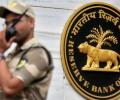
The Reserve Bank of India on Wednesday retained the economic growth projection for the current financial year at 10.5 per cent, while cautioning that the recent surge in COVID-19 infections has created uncertainty over the economic growth recovery. In its last policy review, the RBI had projected a GDP growth rate of 10.5 pc for FY'22. Taking various factors into consideration, it said, "the projection of real GDP growth for 2021-22 is retained at 10.5 per cent consisting of 26.2 per cent in Q1, 8.3 per cent in Q2, 5.4 per cent in Q3 and 6.2 per cent in Q4."

India is currently a relatively small market for the US, in terms of total US exports.

The government should bring natural gas under the Goods and Services Tax (GST) regime to realise Prime Minister Narendra Modi's vision for a gas-based economy and raising the share of the environment-friendly fuel in India's energy basket, an industry body that represents the likes of Reliance Industries as well as state-owned firms, has said. Natural gas is currently outside the ambit of GST, and existing legacy taxes -- central excise duty, state VAT, central sales tax -- continue to be applicable on the fuel. In its pre-Budget memorandum to the finance ministry, Federation of Indian Petroleum Industry (FIPI), which boasts of members from across the oil and gas spectrum, also demanded rationalisation of GST on transportation of natural gas through pipeline as well as on re-gasification of imported LNG to help bring down cost of the environment friendly fuel.

In terms of stock selection, India continues to benefit from two phenomena - the big getting bigger and availability of quality stocks in relative abundance compared with its Asian peers.
